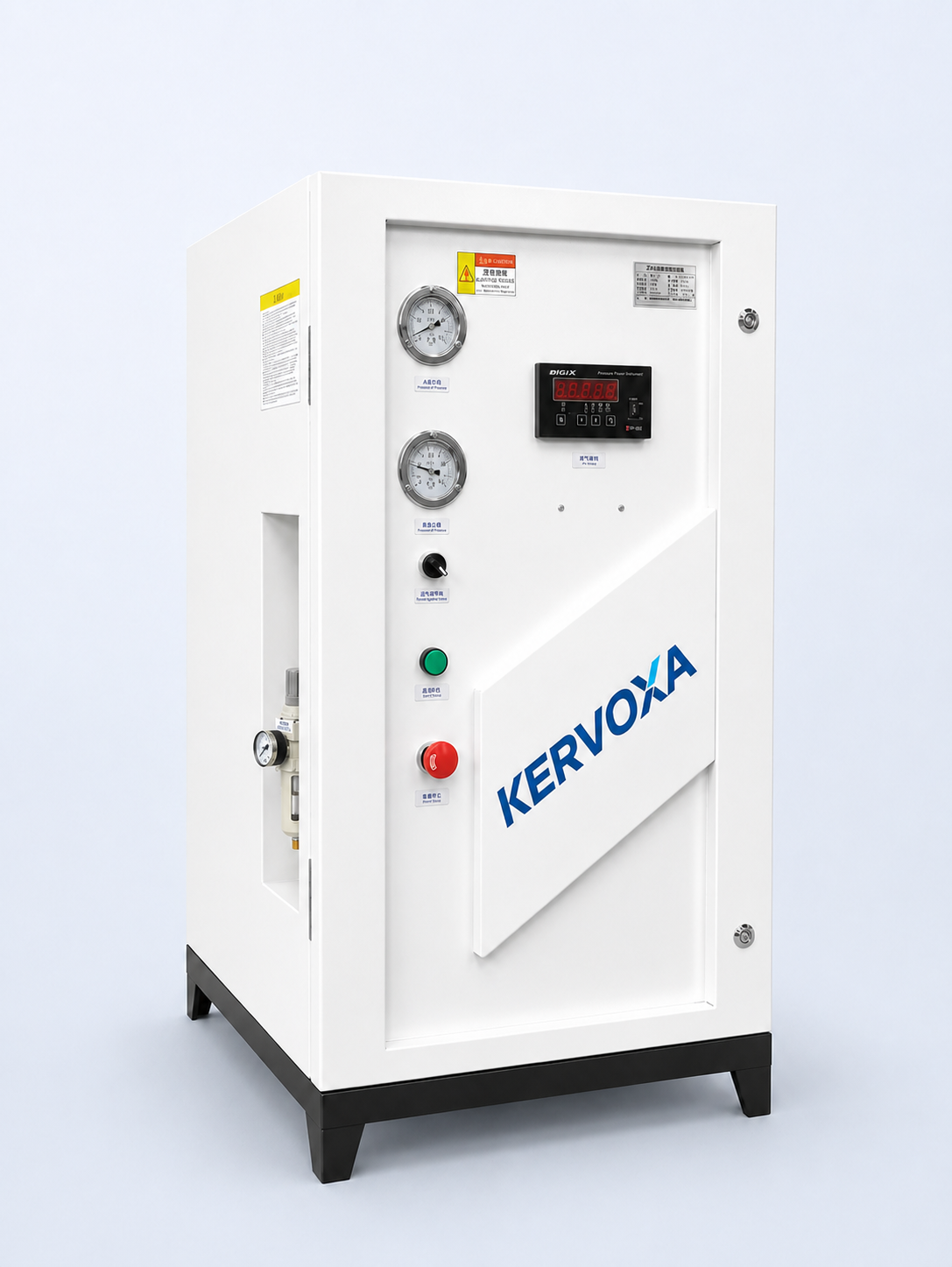
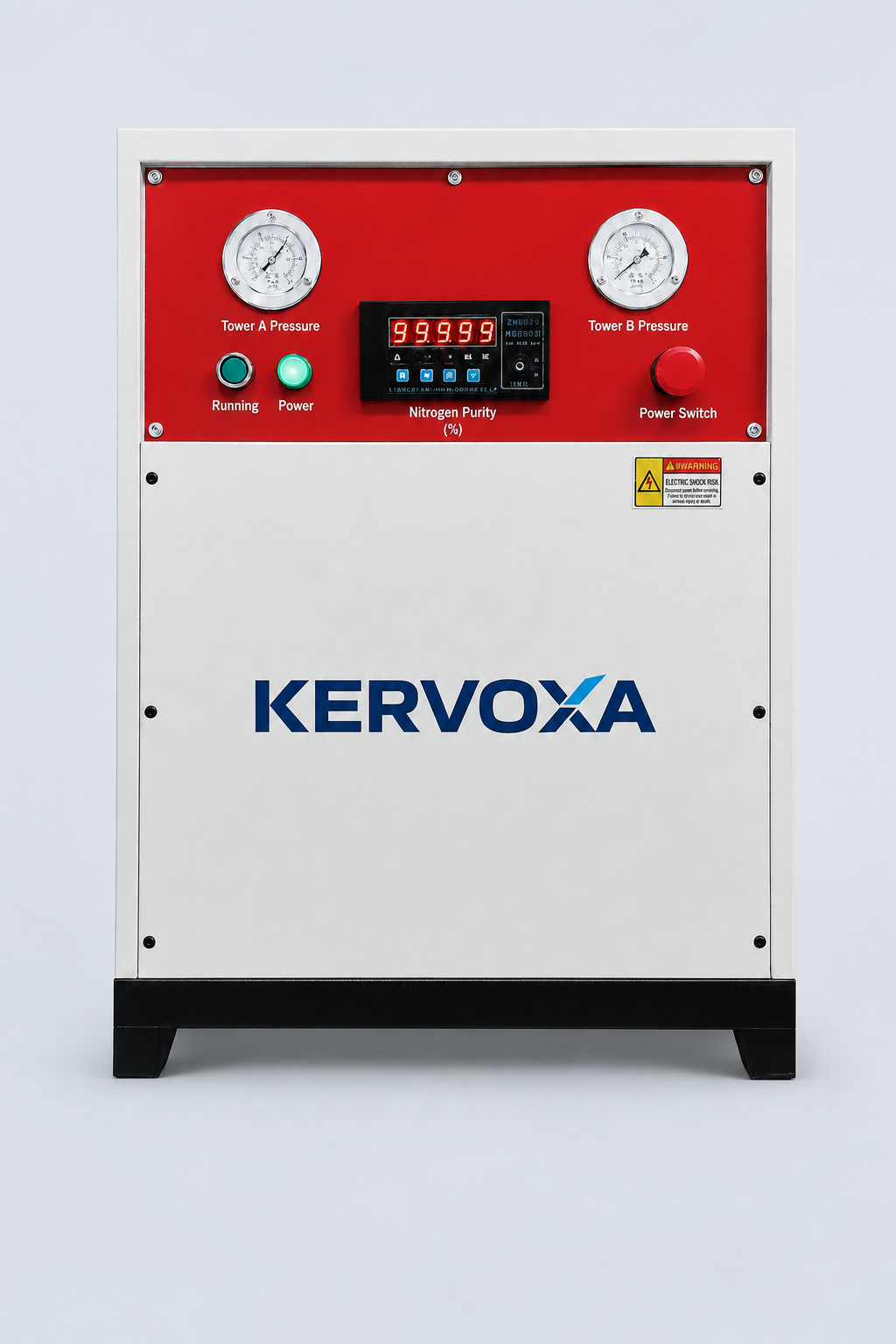
KX-101
1.2 Nm³/hCompact-capacity model for smaller laser welding installations.
- Typical application
- Single or low-demand welding setup
- Cabinet format
- Compact
Request a System RecommendationKX Series for laser welding
Six models covering 1.2–6.0 Nm³/h with 99.999% N₂ purity for handheld, robotic and multi-station laser welding.
Final model selection depends on actual nitrogen demand, operating pattern and available compressed-air conditions.

KX Series positioning
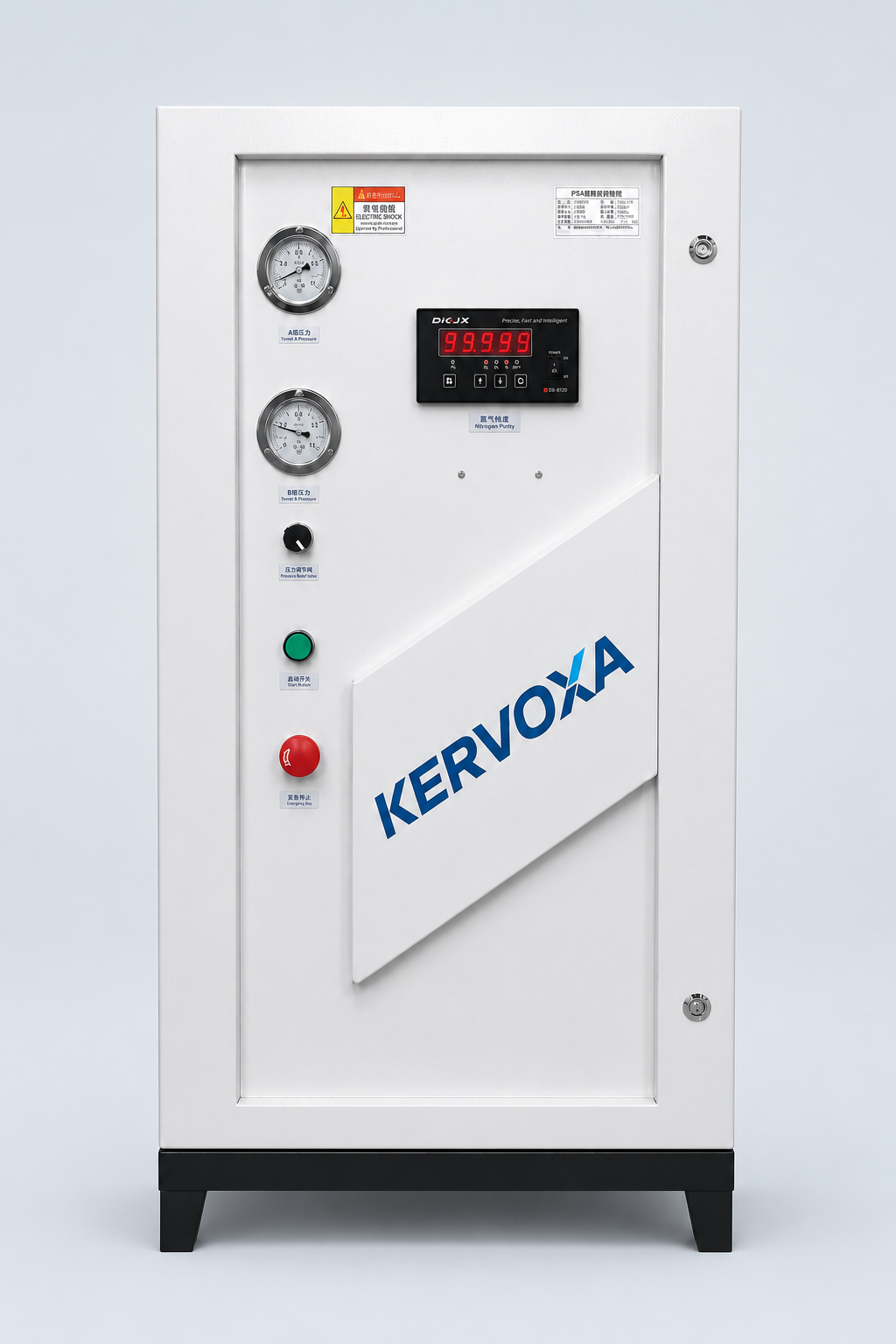
The KX Series uses two cabinet formats across six flow capacities. Select the required nitrogen capacity first, then confirm the final model against actual welding demand and operating conditions.

Compact-capacity model for smaller laser welding installations.

Higher-capacity models for larger, continuous or multi-station laser welding demand.
Technical design details
Stable nitrogen generation depends on more than rated capacity. The CMS bed, adsorption cycle, pressure transitions and pneumatic controls are engineered to work as one system.
The CMS bed is mechanically compressed within a flange-sealed structure to help maintain packing stability during repeated adsorption and regeneration cycles.
A controlled 50-second adsorption cycle coordinates adsorption, regeneration and pressure transitions between the two PSA towers. Consistent cycle timing supports repeatable separation performance during continuous operation.
Pressure equalization between the PSA towers reuses residual pressure during switching and reduces abrupt pressure changes inside the adsorption beds. This helps reduce mechanical stress on the CMS and supports smoother cycle transitions.
Pneumatic valves and fittings are selected for repeated PSA switching cycles and stable operation across normal industrial conditions. Key switching functions use established industrial pneumatic components, including Airtac solenoid valves.
Model comparison
Compare flow capacity, installation data and application estimates across the KX Series.
Customized voltage and frequency available according to destination requirements.
| Model | N₂ flow (Nm³/h) | Estimated Handheld Welders* | Estimated Robotic Stations* | Generator power | Air inlet size | Dimensions (W × D × H) | Weight |
|---|---|---|---|---|---|---|---|
| KX-101 | 1.2 | 1–2 | 1 | 45 W | Ø8 mm | 570 × 370 × 780 mm | 70 kg |
| KX-102 | 2.4 | 2–4 | 2 | 65 W | Ø12 mm | 580 × 500 × 980 mm | 105 kg |
| KX-103 | 3.3 | 3–5 | 3 | 65 W | Ø12 mm | 630 × 600 × 1040 mm | 135 kg |
| KX-104 | 4.0 | 4–6 | 4 | 65 W | Ø12 mm | 630 × 600 × 1040 mm | 155 kg |
| KX-105 | 5.0 | 5–7 | 5 | 65 W | Ø12 mm | 630 × 600 × 1040 mm | 175 kg |
| KX-106 | 6.0 | 8–10 | 6 | 85 W | Ø12 mm | 630 × 600 × 1040 mm | 228 kg |
*Application estimates are based on typical laser welding use. Final model selection depends on actual nitrogen consumption, simultaneous operating demand, duty cycle and compressed-air conditions.
Download Product CatalogueSelection guidance
Welder quantity is only a starting point. Final model selection also depends on nitrogen demand, operating pattern and available compressed-air conditions.
Confirm handheld or robotic use, number of stations and simultaneous operation.
Confirm required nitrogen flow, purity and outlet pressure.
Consider operating hours, duty cycle and simultaneous gas demand.
Verify available airflow, pressure and air-treatment conditions.
Verification before shipment
Each system is checked for nitrogen purity, operating pressure, leakage and control response before shipment.
Nitrogen purity is checked at the outlet after the system reaches stable operation, using the installed nitrogen purity analyser. Gas below the configured purity threshold is automatically vented instead of being supplied to the welding process.
Operating pressure and system response are observed during normal PSA operation to confirm stable gas delivery.
Air and nitrogen connections, valves and fittings are checked for leakage. Normal control sequences, purity venting and switching response are also checked during operation.
Model recommendation
Send us your welding-machine type, quantity, operating hours, nitrogen requirements and existing compressed-air details for a system recommendation.